هذا المقال منشور بالإنجليزية.
A new home gets built when its sale price covers the cost of delivering it. In much of London and the Home Counties, that sum no longer works.
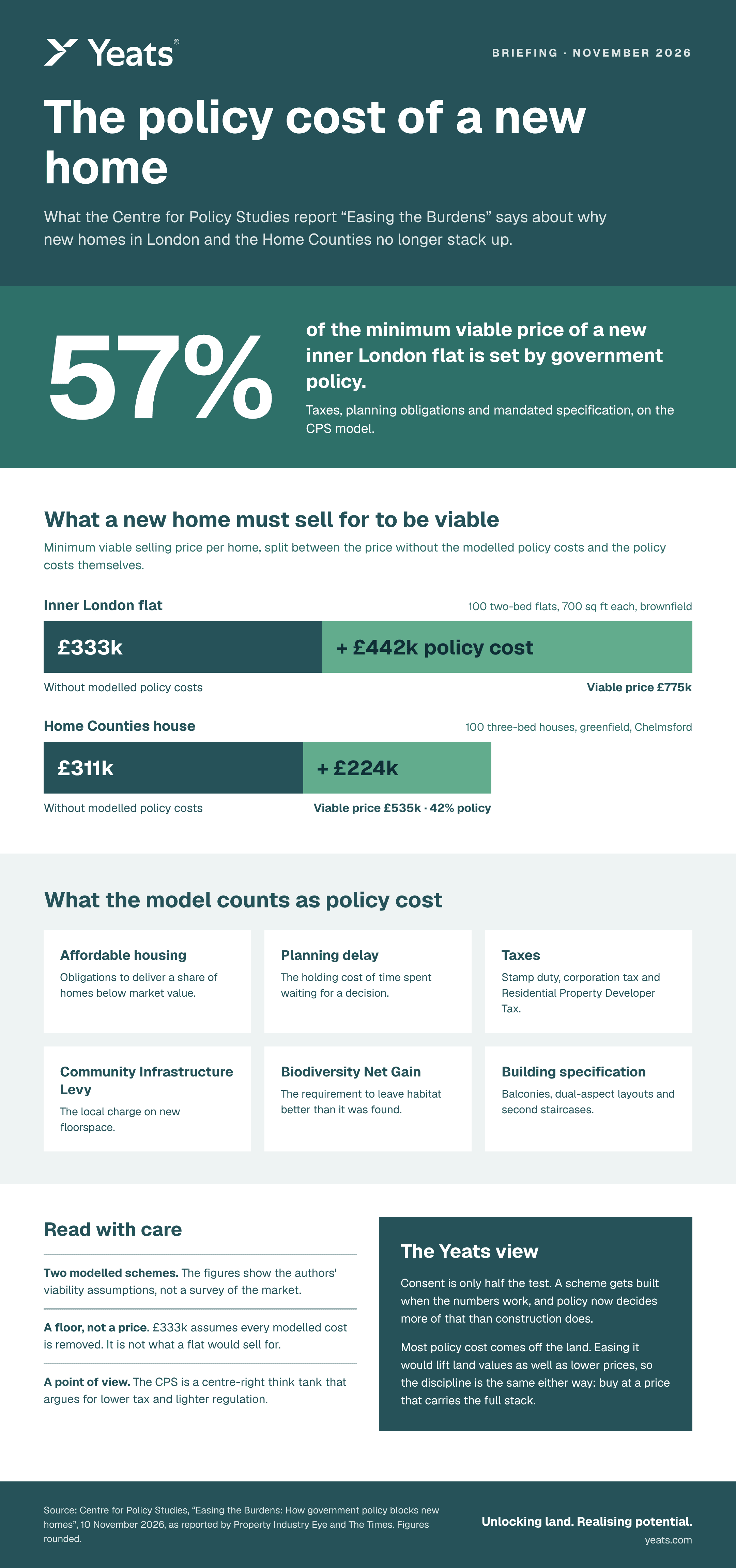
A report from the Centre for Policy Studies, Easing the Burdens: How government policy blocks new homes, puts a number on why. On its model, government-imposed costs account for 57% of the minimum viable selling price of a new-build flat in inner London. For a greenfield housing scheme in the Home Counties the figure is 42%.
The numbers
The authors, Edward Donovan and Ben Hopkinson, modelled two schemes of 100 homes each and asked what every home would need to sell for before anyone would build it.
- Inner London, two-bed flats of 700 sq ft on brownfield land. Each flat needs to sell for about £775,000. Without the modelled policy costs the figure is £333,000, a difference of £442,000.
- Chelmsford, three-bed houses on greenfield land. Each house needs to sell for about £535,000. Without the modelled policy costs the figure is £311,000, a difference of £224,000.
Where local values cannot support the required price, the scheme does not start.
What is in the stack
No single charge does the damage. The model adds up everything a scheme carries between land purchase and sale:
- Affordable housing obligations
- Planning and the delay that comes with it
- Corporation tax, stamp duty and the Residential Property Developer Tax
- Other levies, including the Community Infrastructure Levy and landfill tax
- Mandated additions such as balconies, dual-aspect units, a second staircase and biodiversity net gain
Each has a rationale of its own. The report's argument is that nobody has been adding them up, and that successive governments have concentrated on planning restrictions while the cumulative bill grew.
How to read the figures
The headline needs care. These are two modelled schemes, not a survey of the market, and the results rest on the authors' assumptions.
The £333,000 figure is a theoretical floor. It assumes every modelled cost is removed, including affordable housing and corporation tax, which no government is likely to do. It is not what a London flat would sell for if the rules changed.
The Centre for Policy Studies is a centre-right think tank that argues for lower taxes and lighter regulation, and its conclusions should be read in that light. Supporters of the current rules would point to what they pay for: affordable homes, safer buildings, local infrastructure and restored habitat.
There is also a question of who bears the cost. In a working land market, much of the policy burden is deducted from what a developer can pay for the site. Easing it would raise land values as well as lower the price a home needs to achieve.
What it means for development
None of that weakens the central point. Viability, not consent, now decides what gets built.
A planning permission is worth nothing if the scheme behind it cannot be funded. Faster decisions help, but they shorten only one line of the appraisal. The rest of the stack is untouched by planning reform.
For developers and their capital partners, three things follow:
- Price the whole stack at acquisition. The policy burden is known on day one. Land bought without it in the appraisal is land bought too dear.
- Treat policy as a moving input. Levies and standards keep changing. Appraisals need headroom for the next change, not only the current one.
- Follow viability across sectors. Where residential numbers fail, the same land may work for other uses with a lighter policy load.
At Yeats, we work across industrial and business parks, self-storage, hotels and living. Each site is tested against every use it could carry, because the best use of land is the one that can be delivered.
Source: Centre for Policy Studies, Easing the Burdens: How government policy blocks new homes, November 2026.